Pulleys with Right Angle Transition
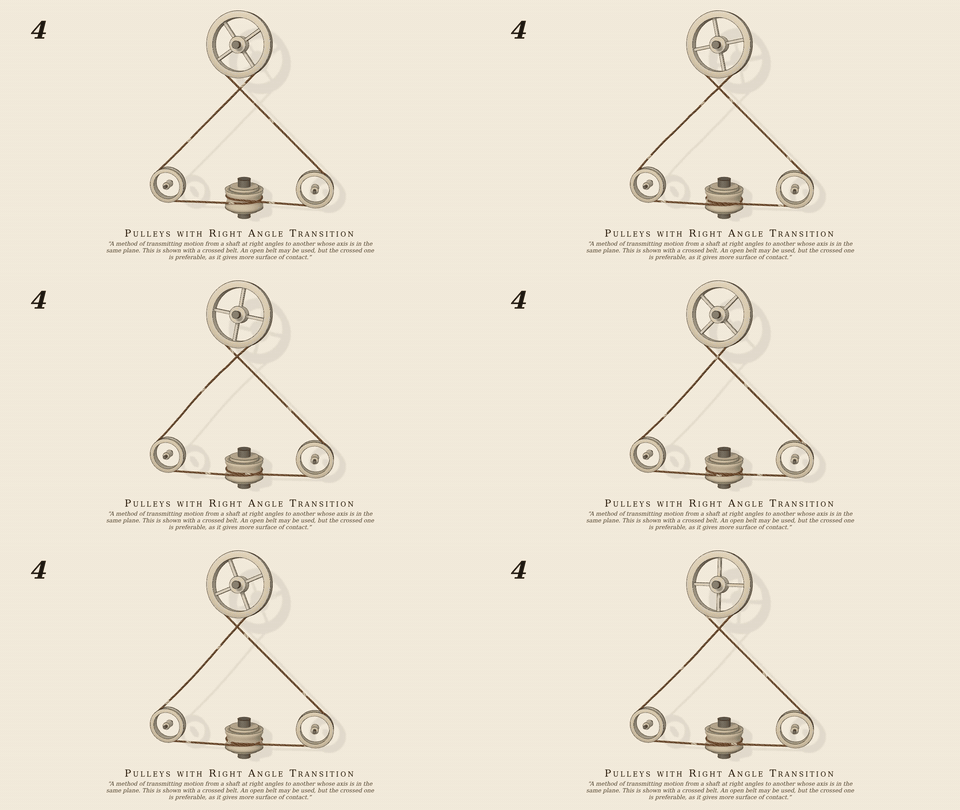
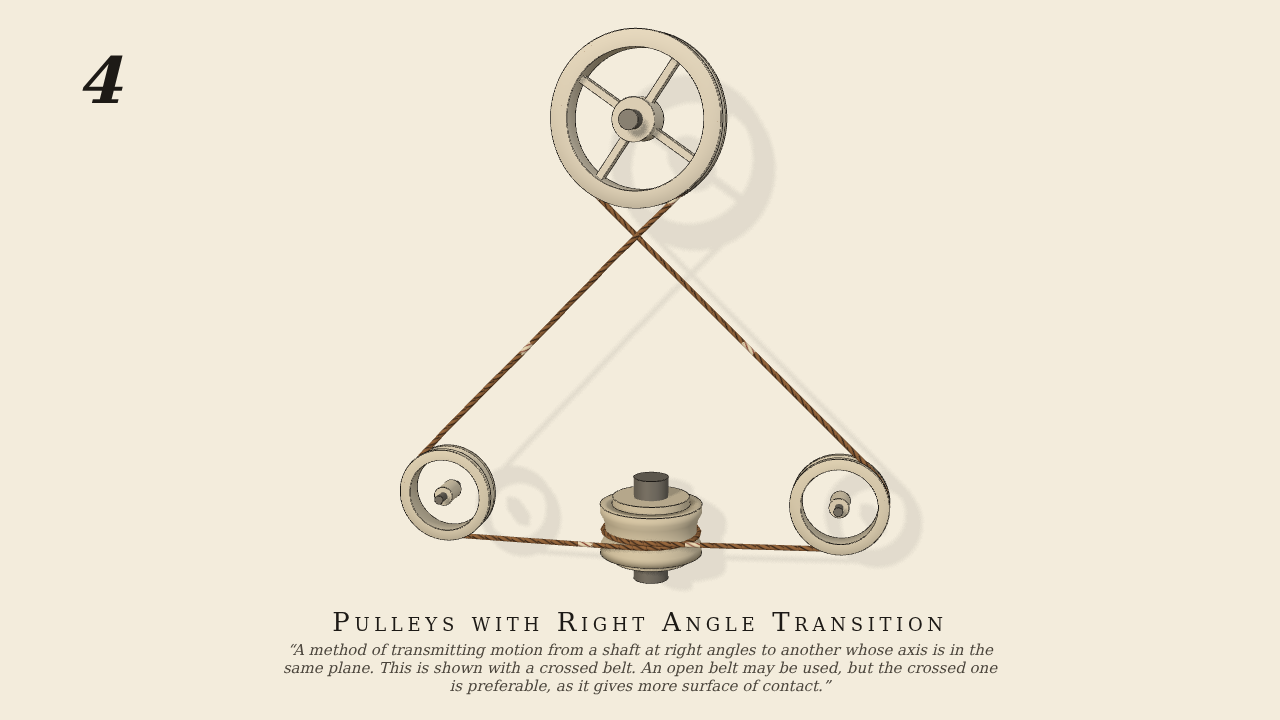
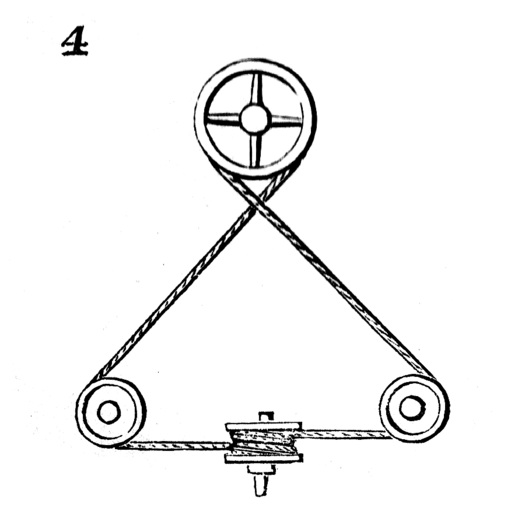
A method of transmitting motion from a shaft at right angles to another whose axis is in the same plane. This is shown with a crossed belt. An open belt may be used, but the crossed one is preferable, as it gives more surface of contact.
Only the input is driven; every other part of this model moves by physics (MuJoCo), and its ratios are measured. Run it live, change its parameters, or switch the friction off to see the output stop.
- Modelled as
- crossed round cord (friction; 150-link elastic chain, 20 N) from the driver down to two guide pulleys on studs square to their runs, a full helical turn round an upright drum whose shaft meets the driver's at right angles; crossing leaves rub
- Measured
- ω_drum/ω_top +1.607 (geometry 1.603), guides −1.785/−1.772 (geometry −1.755); steady over an 8 s soak; leaves touch at the cross, ≤0.19 mm; μ≈0 control 0.000
- Notes
- Only the driving pulley is motor-driven. Drum face is smooth (Brown's spiral groove not cut): the turn settles down it, cord ≤2.2 cm off its nominal helix; leaves press the driver's flange edges (pen ≤3.0 mm). Cord sub-chains carry a whisker of root damping so straight runs cannot spin about their own axis.
Film (MP4) · GIF · Still (PNG) · Spec (YAML) · Model (MJCF)