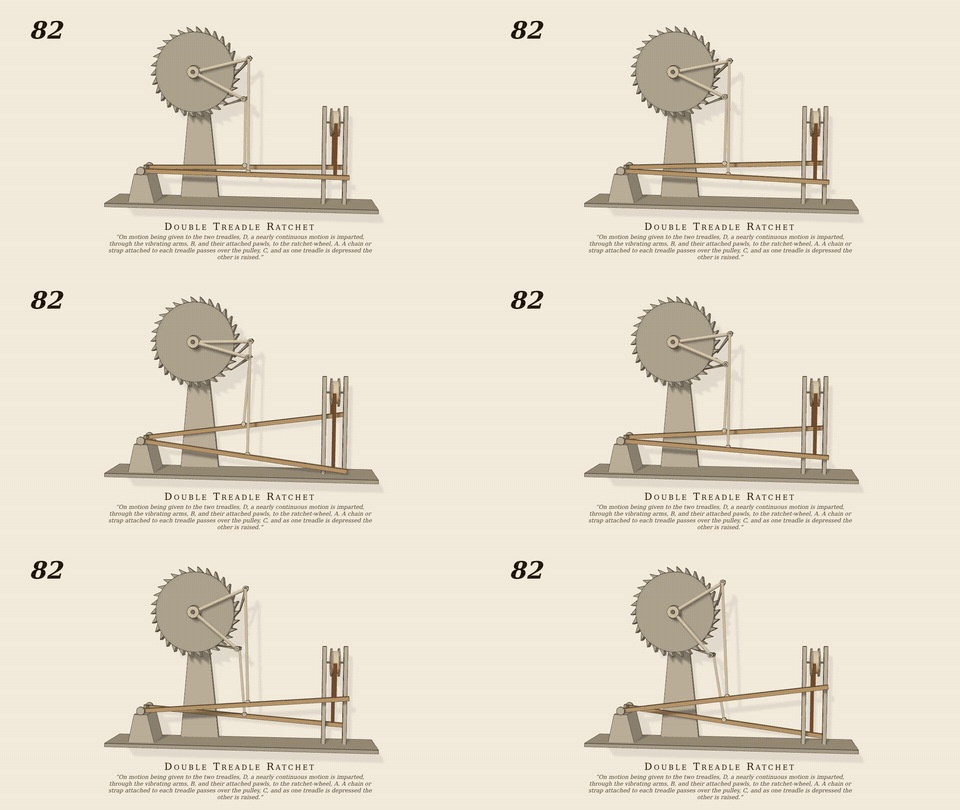
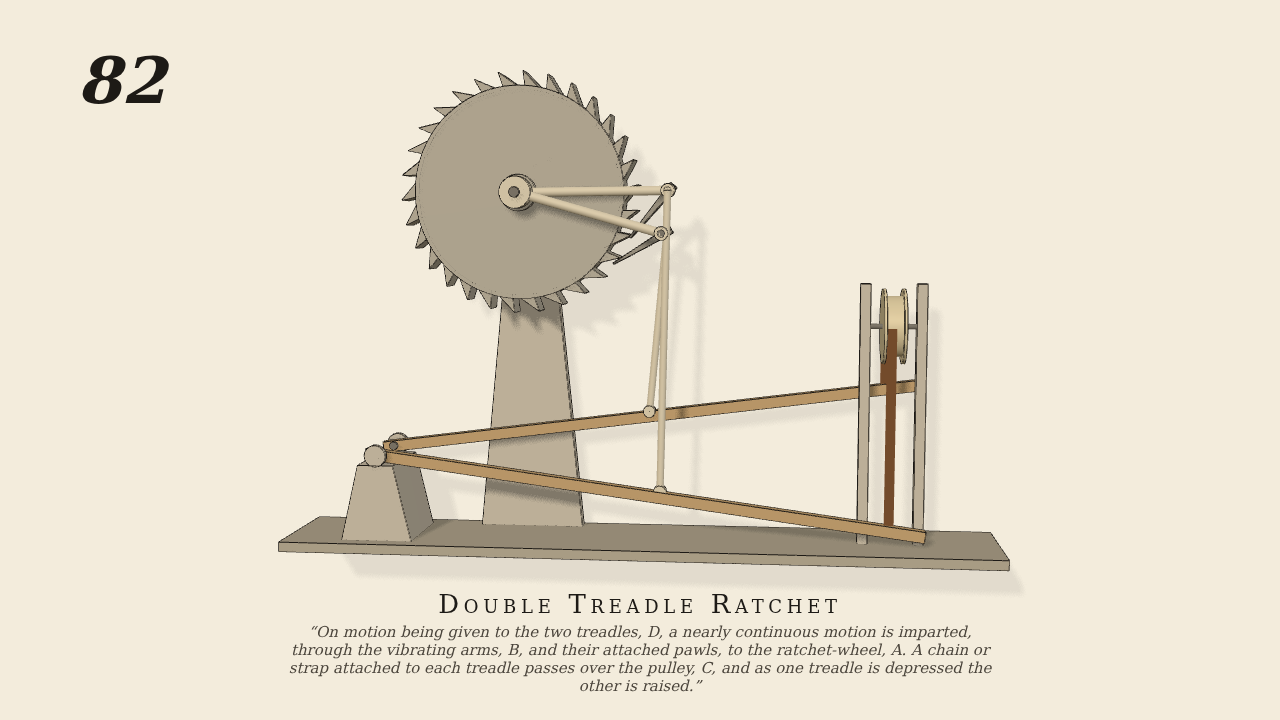
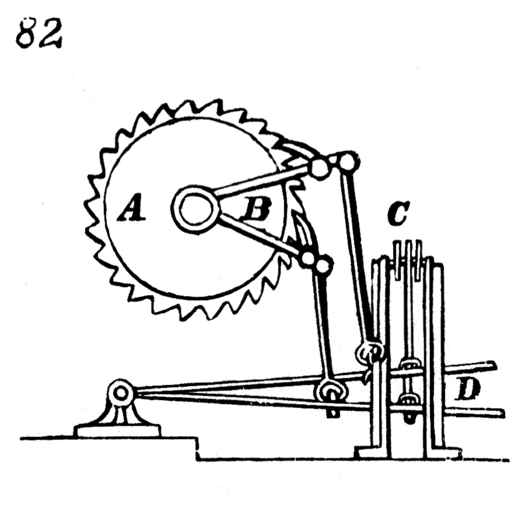
Double Treadle Ratchet
On motion being given to the two treadles, D, a nearly continuous motion is imparted, through the vibrating arms, B, and their attached pawls, to the ratchet-wheel, A. A chain or strap attached to each treadle passes over the pulley, C, and as one treadle is depressed the other is raised.
Only the input is driven; every other part of this model moves by physics (MuJoCo), and its ratios are measured. Run it live, change its parameters, or switch the friction off to see the output stop.
- Modelled as
- ratchet (contact only: two sprung pawls on arms B loose on A's shaft against 30 hooked teeth; links to two treadles pinned to them; strap over C as a tension-only tendon; two feet, each press-only, alternately)
- Measured
- A turns one way at a mean 1.09 rad/s (10.4 rev/min), never below 0.27× the mean, largest run-back 0.000 rad; pawls click over the teeth 5–6 times a second each (83% / 63% on their arm's return stroke, the rest when A runs ahead); back treadle follows the front at slope −1.000 (r² 0.99) through the strap; penetration 0.28 mm
- Notes
- Inputs are the two feet (0.5 N·m half-sine, 60 strokes/min each); load on A 0.06 N·m·s/rad. C is a fixed round: the strap slides over it frictionlessly, so C does not turn.
Film (MP4) · GIF · Still (PNG) · Spec (YAML) · Model (MJCF)